
You quoted $997. They blinked. You felt the silence get heavy, and before you could stop yourself:
"Look, I might be able to do $797 for you."
The deal closed. You felt the rush of a win. And somewhere deep down, a small voice said: you didn't have to do that.
That voice is right. And if this has happened more than once, it's not a tactics problem. It's a reflex — and reflexes can be rewired.

A hand in a blue shirt cuff holding a red "DISCOUNT" rubber stamp above a proposal document, hovering without stamping it.
The discount trap
Here's what discounting actually does to your sales:
It trains prospects to wait. Every discount teaches the market one lesson: the first price isn't the real price. Next time, they push harder, earlier. You created this dynamic.
It cheapens your solution. Prospects don't do the math on your margin — they read a discount as information about value. If you can drop the price that easily, maybe it was never worth what you asked.
It costs more than the money. This is the one nobody talks about. The deals you discount are the deals that leave you hollow. You got the signature, but you lost the feeling of being worth what you charge. That erosion compounds.
I know this because I lived it. There were quarters where I discounted my way to target and hit the number — and still felt like a worse salesperson than the guy who missed it clean.
Why you reach for the discount
Most discounting isn't a strategy. It's self-defense. Underneath the reflex, one of three things is running:
1. You don't fully believe your own price. If you'd flinch buying at full price, you project that flinch onto the prospect. You're negotiating with your own doubt, not with them.
2. You fear the no more than you want the yes. A discounted yes feels safer than a full-price maybe. But a discount that buys a yes just postpones the no — to the renewal, the referral, the testimonial that never comes.
3. You confused their hesitation with your inadequacy. They paused, and your brain filled the silence with they think it's too expensive instead of they're doing mental math. You answered a question they never asked.
Notice the pattern: none of these are about the actual price. The price is almost never the real problem. The real problem is what the price conversation triggers in you.
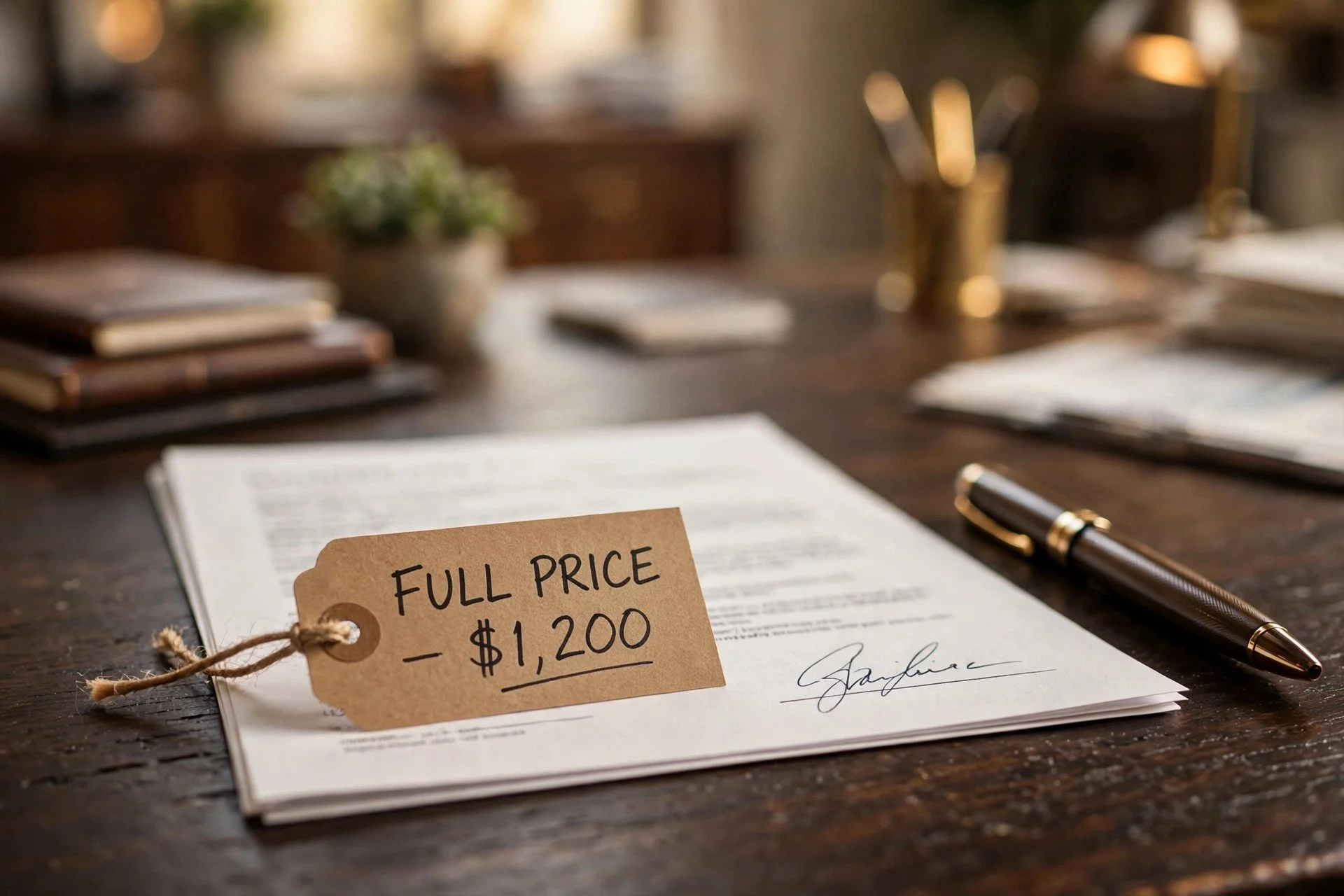
A kraft paper tag reading "FULL PRICE — $1,200" resting on a signed sales contract next to a fountain pen on a dark wooden desk, warm office lighting.
What to do instead: the anchor test
Next time you feel the discount reflex rising, run this test before you touch your price:
Step 1: Name the real objection. Ask: "Is it the price itself, or is something about the value not clear yet?" Said calmly, this separates genuine budget constraints from vague hesitation. Most of the time, it's the second one — and you can't fix a value gap with a price cut.
Step 2: Hold the line for one round. When they say "that's more than I expected," resist the urge to respond with a number. Respond with a question: "What were you expecting to invest to solve this?" Make them put their anchor down. Nine times out of ten, their number isn't far off — they just wanted you to move first.
Step 3: Add before you subtract. If the gap is real, offer more value before you ever offer less price. "I can't move on the price, but here's what I can do..." Extra support, a faster start, a small bonus. This keeps your price intact while still meeting them halfway — and prospects respect it more.
Step 4: If you must discount, make it cost something. Never discount for free. Tie it to something — a shorter decision timeline, payment upfront, a testimonial, a second referral. "I can do that if we get started this week." A discount with a condition is a negotiation. A discount without one is a confession.
The inner-game shift
Here's the uncomfortable truth I share with my coaching clients: chronic discounting is a confidence problem wearing a sales problem's clothes.
Salespeople who hold their price aren't tougher or better at sparring. They've just done the inner work: they believe the price is fair, they can sit in silence without flinching, and they've stopped treating a prospect's hesitation as a referendum on their worth.
That steadiness is what makes the anchor test work. The questions are simple — any salesperson could ask them. The hard part is asking them without your voice shaking. And that's trainable.
Your next step
Think about your last three deals. Did you discount because the deal required it — or because the silence scared you?
If you're tired of winning deals that leave you feeling like you lost, let's talk it through. Book a free Activation Session and we'll look at where your pricing confidence breaks down — and how to rebuild it.
